Three minutes of weightlessness, and your hardware back afterwards
Suborbital flights for scientific and commercial payloads, launched offshore in the North Sea and recovered. Approximately 195 seconds at better than 10−4 g — 222 seconds at better than 10−3 g — for a payload of up to 50 kg. The span between what a drop tower can give you and what costs years of waiting for a slot on the ISS.
How long do you actually need?
Most experiments are shaped by whichever platform the team could get access to, rather than by the science. These are the realistic options in Europe today.
Drop tower
~5 s
Cheap and repeatable. Long enough for physics, too short for most biology.
Parabolic flight
~20 s
Many parabolas per campaign, but each one is brief and the g-transitions are sharp.
EuroSpaceport
195 s
At better than 10−4 g, in one clean continuous run. Payload recovered and returned to you.
ISS
Months
Unmatched duration, at the cost of years of queue, high price and heavy qualification.
The numbers you need to design against
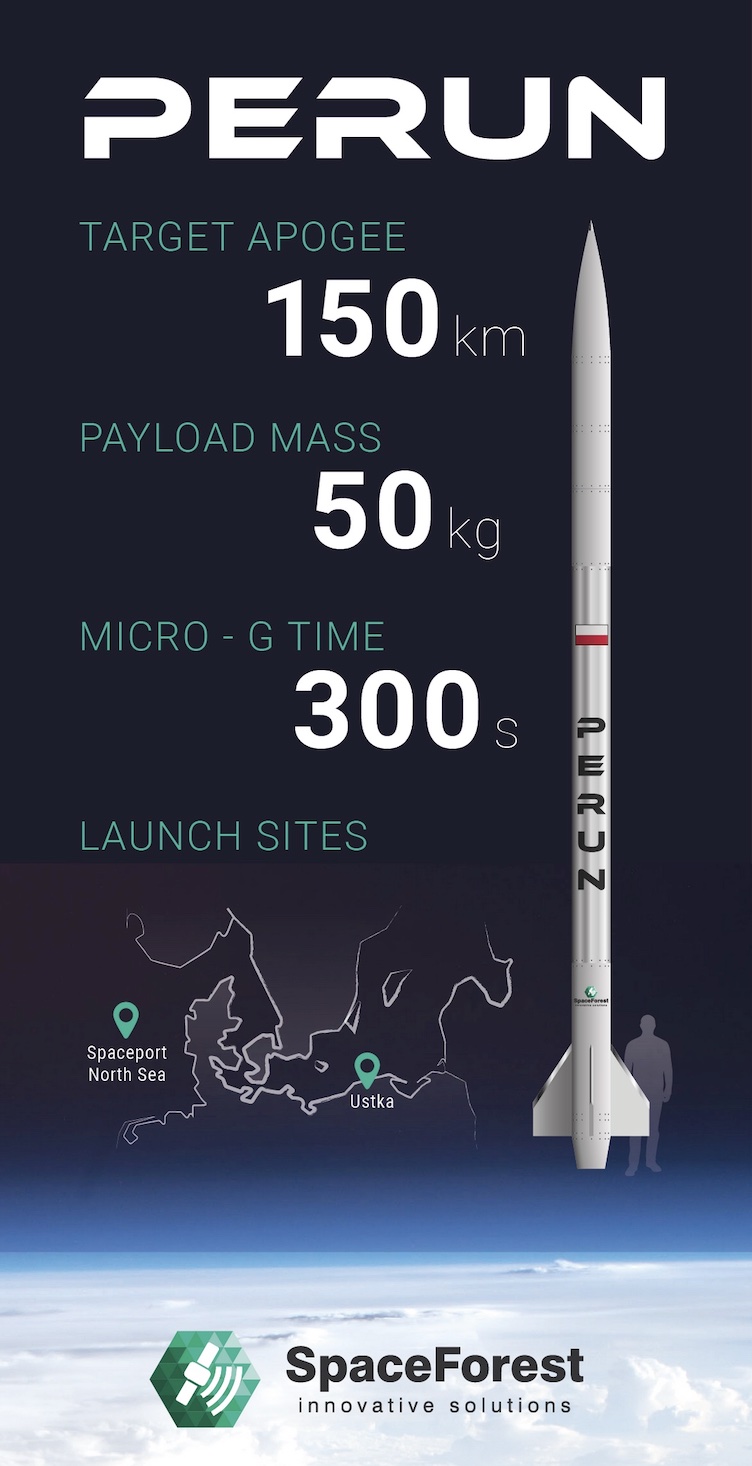
- Microgravity ~195 s at <10−4 g
~222 s at <10−3 g - Payload mass up to 50 kg
- Payload envelope ~800 mm high × 377 mm dia.
- Apogee ~100 km (Mission 1)
up to 150 km capability - Power to payload On request
- Data & telemetry On request
- Peak axial load On request
- Recovery ballute-assisted, sea recovery
- Late payload access up to ~1 h before flight
- Launch vehicle PERUN (SpaceForest)
single-stage hybrid, TVC
N2O + modified paraffin
Designing something that does not fit this envelope? Tell us anyway — the platform is more adjustable than a fixed range.
A flight, not a list of problems
The reason experiments do not fly is rarely the science. It is approvals, logistics, propellant handling and the discovery that somebody has to charter a vessel. Those are ours, not yours.
Regulatory approvals
Launch licensing, airspace and maritime coordination, handled from an EU member state.
Integration facility
Prepare and integrate your payload on the Danish west coast, 85 km from the German border — reachable by road from most of Europe.
Offshore operations
Vessels, crew and range operations run by companies with decades of North Sea experience.
Safety & security
Launched offshore, more than 50 km from any resident or permanent structure — the exact position is chosen per mission by the safety analysis. Site security included.
Propellants
Supply and handling, with the licensing that goes with it.
Recovery & return
Ballute-assisted descent and sea recovery by support vessel and fast boats. Your hardware comes home.
From first email to data in hand
- Enquiry. Tell us the experiment, the mass and the microgravity duration you need. No NDA required to start.
- Feasibility. We confirm the payload fits the envelope and the flight profile suits the science, and quote.
- Interface agreement. Mechanical, power and data interfaces fixed in writing so you can build against them.
- Integration. Your payload arrives at our facility in the weeks before the window and is integrated with our team.
- Launch. Offshore, from the launch vessel. You are welcome aboard or ashore to watch it.
- Recovery and return. Payload recovered, data delivered, hardware returned after recovery and inspection.
Next flights
Our first offshore mission flies SpaceForest's PERUN rocket in H1 2027, part-funded through ESA's Boost! programme. It is a technology demonstration: the flight that proves we can run offshore launch operations safely and repeatably. Customer payload capacity follows from there — and the manifest for those flights is being built now — Mission 1 itself flies ~50 kg of university, institute and commercial experiments.
Tell us about your experiment
Four things let us answer properly rather than with a brochure. If you do not know all of them yet, send it anyway — working that out is part of what we do.
Prefer email? CEO Nicolas Kristoffersen — nk@eurospaceport.com / +45 2022 0044
© 2020–2026 EuroSpaceport. Danish Company Registration CVR: DK-41765739